You’ve probably heard about “AI agents” in recent months. It sounds futuristic, a bit vague, and you’re probably wondering: OK, but what does it actually do for my business?
Good news: it’s much simpler (and more useful) than you think.
What is an AI agent ?
An AI agent is intelligent software that performs tasks autonomously. It doesn’t just answer your questions like ChatGPT – it’s a tool that acts on your behalf.
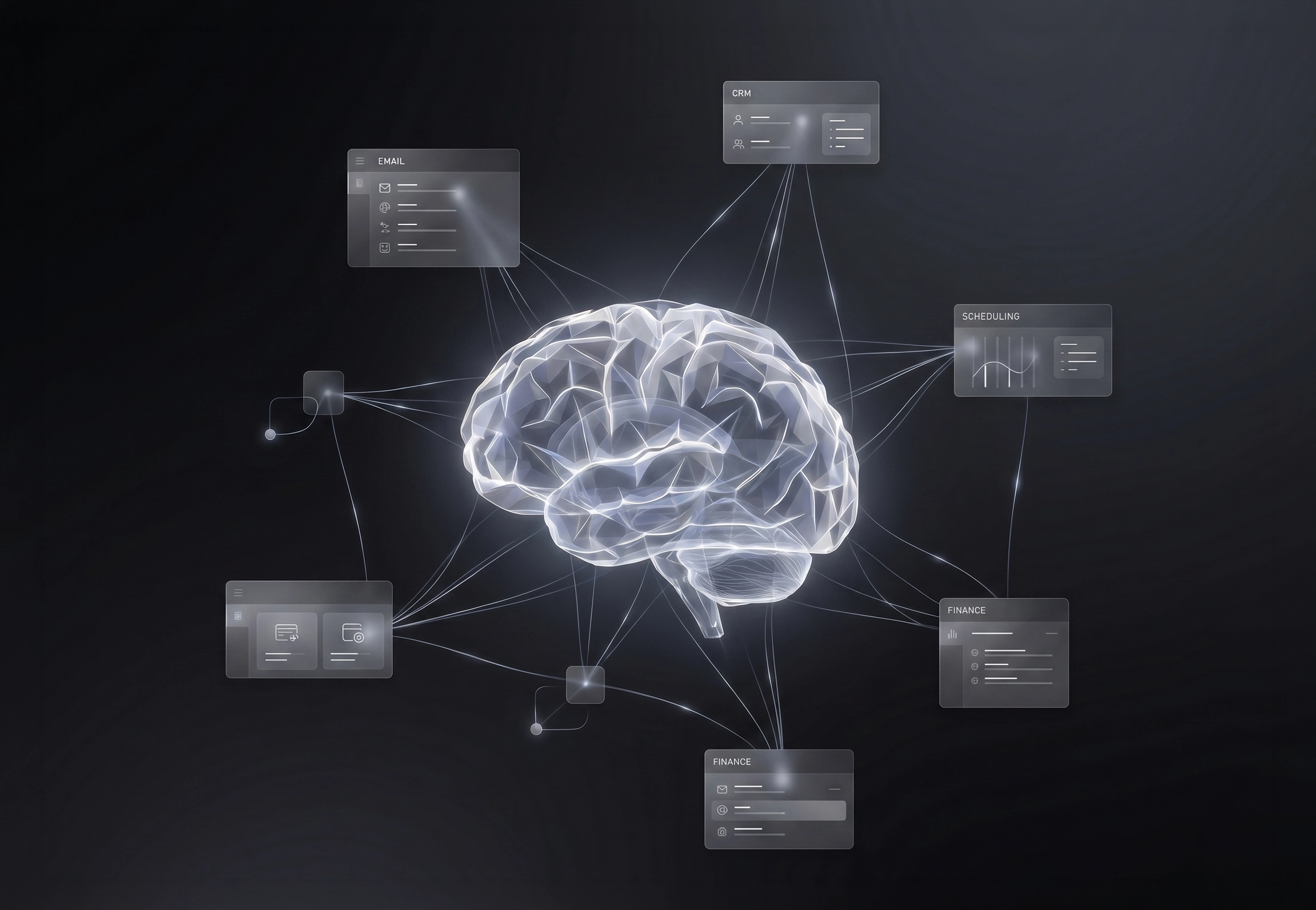
It analyses situations, makes decisions based on rules you define, and takes concrete actions. It can interact with your systems (CRM, calendar, inventory), send emails, schedule follow-ups, and fill out forms.
Think of it as a digital employee who works 24/7, never takes a coffee break, and never gets tired of repetitive tasks.
Some concrete examples in an SME
Automated customer service : A customer sends an email late at night to cancel their order. The AI agent reads the message, checks the order status in your system, processes the cancellation, updates the inventory, and sends a confirmation to the customer. All without human intervention.
Sales follow-up : Your AI agent detects that a prospect has not responded in 5 days. It automatically sends a personalised follow-up email, tailored to the context of the previous conversation. If the prospect responds, it alerts your team. If not, it schedules another follow-up in 7 days.
HR management : A new employee starts on Monday. The agent creates their email account, adds them to the right Slack groups, schedules their training, prepares their schedule for the first week, and sends a welcome message with all the important documents.
Invoicing and reminders : At the end of the month, the agent generates invoices, sends them to customers, and tracks payments. If an invoice is over 30 days past due, they send a polite reminder. At 60 days, they alert your accounting team.
Recognize the pattern? These are all tasks that someone on your team does manually today.
The real impact on your operations
According to Gartner, by 2028, 33% of enterprise software applications will incorporate AI agents. But beyond the statistics, what does this mean for you?
Time saved : Your employees no longer spend two hours a day on administrative tasks. They can focus on what really grows your business: selling, creating, innovating.
24/7 responsiveness : Your customers get instant answers, even at midnight on a Sunday. This improves the customer experience without forcing you to hire more staff to cover all shifts.
Fewer errors : An AI agent doesn’t get tired, forget to send an email, or mix up two files. It performs consistently.
Controlled costs : You don’t pay salaries, benefits, or overtime. The initial investment quickly pays for itself when you calculate the time saved.
What an AI agent does (and does not do)
What it does:
- Works continuously without supervision
- Makes decisions based on rules you define
- Improves over time thanks to data
- Integrates with your existing tools (CRM, ERP, email, etc.)
What it doesn’t do :
- Replace your strategic judgement
- Make creative or emotional decisions
- Work perfectly overnight (it needs to be configured and adjusted)
How much does it cost ?
The real answer varies greatly. A simple agent can cost a few hundred dollars per month. A more complex system with several integrated agents can cost several thousand.
But look at it this way: if the agent frees up 10 hours per week of an employee earning $25/hour, you save $1,000 per month. The return on investment comes quickly.
Where to start ?
Identify a task that your team repeats every week. Something predictable, with clear steps. That’s your ideal starting point.
At P3F, we don’t develop “generic” AI agents. We take the time to understand your operations, your pain points, and your processes that are holding you back.
Then we design a custom agent that integrates with your current tools and solves your specific problems. Not a technological gadget – a real helping hand for your team.
We also support you after launch to adjust and optimize. Because an AI agent evolves with your reality.
Want to see how an AI agent could transform part of your operations?